Divinity Original Sin 2 Spirit Vision
A CRPG of unparalleled breadth and dynamism, Original Sin 2 is Larian's masterpiece.
- Divinity Original Sin 2 Infinite Spirit Vision
- Vilnx Creeva
- Divinity Original Sin 2 Spirit Vision Missing
Subreddit for discussions about Divinity: Original Sin, Divinity Original Sin 2, and other Larian Games. Credits and distribution permission. Other user's assets All the assets in this file belong to the author, or are from free-to-use modder's resources; Upload permission You are not allowed to upload this file to other sites under any circumstances.
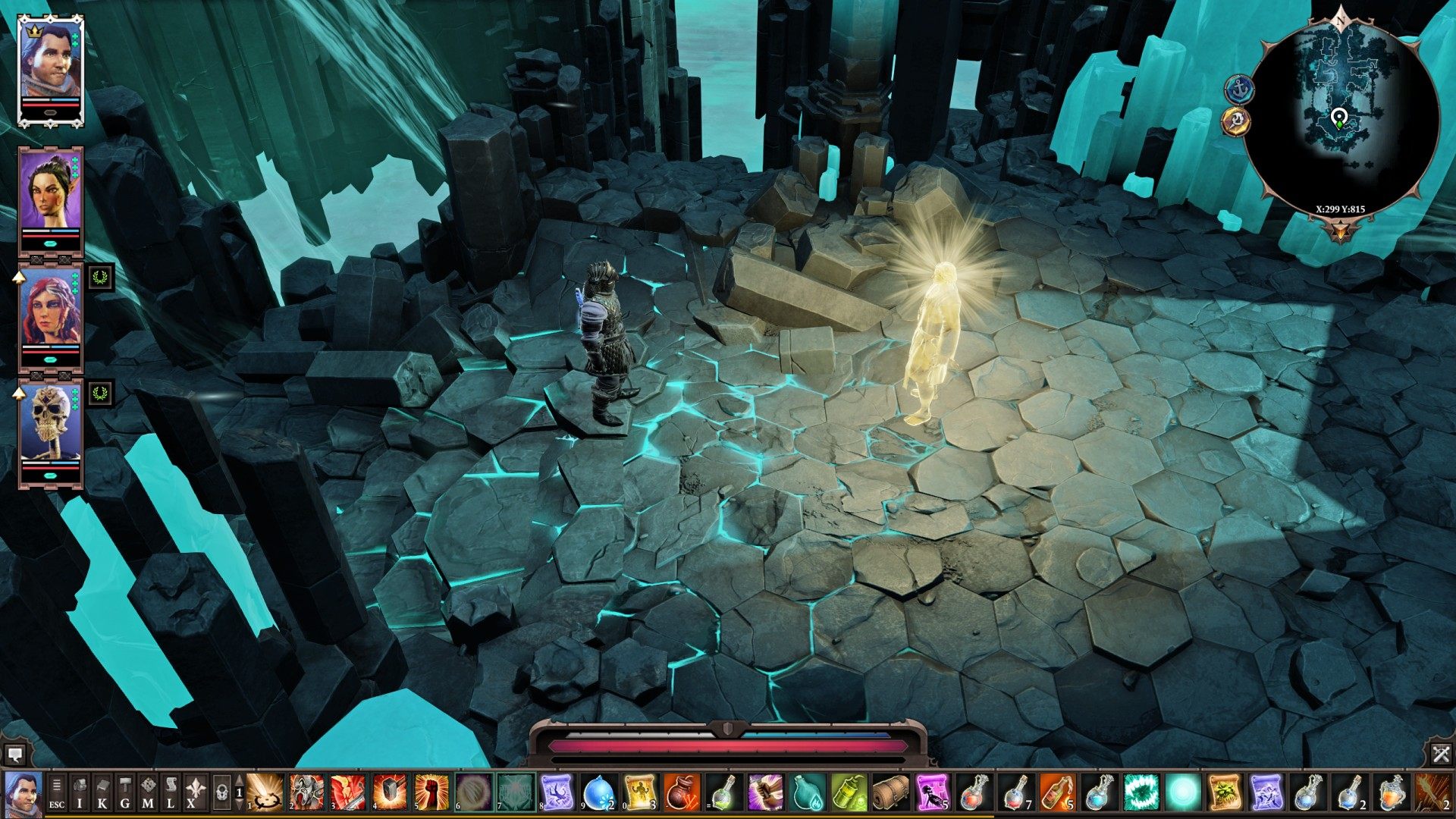
About halfway through Original Sin 2's campaign, you acquire the ability to talk to ghosts. Cast 'Spirit Vision' in any given area of its massive, detailed world, and any nearby souls waiting in the queue to the afterlife will be revealed to you, their transparent outline glowing with a greenish hue.
In other games, this would be a neat gimmick useful in a few specific circumstances. In Original Sin 2, it's like putting on the glasses in John Carpenter's They Live. It changes everything. Suddenly, the world becomes alive with the dead. They wander through the streets, linger amongst revelling tavern patrons, hover over battlefields staring at their own corpses.
You've been given the keys to a whole new reality, and it's going to unlock a lot of doors. Remember that murder you were investigating? Never mind finding the murder weapon or an incriminating letter, just ask the victim whodunit. Looking for a secret passage in a dungeon? Maybe there's another, less fortunate adventurer floating around you can glean some advice from.
It's a revelatory feeling, and it isn't the first or last time that Original Sin 2 evoked such a sensation within me. Indeed, it's just one example of a theme that defines Original Sin 2: nothing is as it seems, and there's always another way of thinking about a situation.
Admittedly, this was more or less the premise of the first game. In fact, at a glance you'd be hard pressed to tell the difference between the two. Original Sin 2 carries over all the best elements of its predecessor along with, annoyingly, a few of its flaws. But as you delve deeper into Original Sin 2's labyrinthine story, it becomes clear the two diverge like grape juice and wine. The former is light, fresh, unadulterated. But things have happened to the latter, and it's come out the other end darker, matured, and delectably intoxicating.
Original Sin 2's cooperative play improves upon the first game in two key ways. Firstly, it lets four players play together rather than two. Secondly, it is lent a competitive edge. This stems from the story's central conceit that you've all been selected for greatness by a different god. Through this you can roleplay either as a close-knit group of comrades, or as a conniving bunch of miscreants ready to stab each other in the back. You can pickpocket one another and attack your friends during combat. You can even craft poisoned food and potions and give it to your 'friends'.
There's also no rules that stipulate you must stick together during play. It's quite possible for one half of your team to wander off into the woods while the other half explores a nearby town. This feature works especially well with the more enigmatic of Divinity's quests, as players can split up and search for leads together, chatting to different NPCs and exploring separate buildings. Of course, there's a chance you might get stuck in a combat scenario that's beyond your solo or split-party abilities, at which point you'd better hope you didn't piss off your mates too much with all your dastardly shenanigans!
Indeed, if there's another theme that defines Original Sin 2, it's corruption. After escaping from the Sourcerer prison of Fort Joy, you and your party embark on a race for power. A malevolent force known as the Void is slowly wrapping its tendrils around the world, and to defeat it one of your party must ascend the status of Divine, a form of godhood previously attained by a Christ-like figure named Lucien.
Alongside your ragtag band are at least a half-dozen other factions scrabbling toward Divinity, from the ruthless Magister sect led by Lucien's own son, Bishop Alexander, to a Necromantic cult known as the Black Ring. Even the Seven, the pantheon of gods whom Lucien once served, have succumbed to bickering and infighting in the shadow of the Void. Their quarrel is so grievous that each god selects a different member of your party to be their 'Chosen One', which has all kinds of potential ramifications for your party's own cooperative efforts.
As the different sides clash and atrocities are committed, what should be a straightforward battle between good and evil turns into a grey malaise where it's hard to tell which side is the most contemptible, let alone who is right. Larian drip-feed the ensuing twists and revelations over many hours, slowly peeling back the skin of each faction and letting you prod at the flesh beneath to decide just how rotten it is.
It's a strong plot, adopting the perspective that everybody is the hero of their own story and rushing into battle with it. Nearly every side has a convincing justification for their actions, but at the same time those actions make you really want to throw them in the biggest fire you can. This notion also applies to your party, who truly can be the hero of the story if you choose to play as one of them. Up to four of a potential seven characters can accompany you on your journey, and their personal tales can be just as compelling as the wider stories being played out in Rivellon.
Divinity Original Sin 2 Infinite Spirit Vision
Take Sebille, an elvish rogue on a bloody quest for revenge. Before you encounter her in Fort Joy, Sebille was a slave and assassin forced to murder countless people by a mysterious figure known only as the Master. Sebille carves a bloody path on her journey through Rivellon, a path that is not always one you want to follow her down. At the midpoint of the game, you need to parley with a mercenary faction known as the Lone Wolves, whom another of your party, a man named Ifan, belongs to. But the leader of the Lone Wolves is responsible for selling Sebille into slavery in the first place. Put her in your party when you speak to them, and there won't be much time for negotiation, what with all the stabbing going on.
The party stories aren't as integral or fleshed out as those in, say, Mass Effect. They tend to occur in short, infrequent bursts. But they're all thoughtfully written and can be very dramatic. The story of Lohse, a flame-haired mage with a demon trapped in her skull, has one of the most stunning visual reveals I've encountered in ages, beautifully set up and executed. The game even uses the characters who don't accompany you on your adventure in clever and surprising ways.
Yet while I enjoyed both the main plot and the backstories to the characters, the best stories in Original Sin 2 are those you stumble upon in the world. I've battled sentient scarecrows, helped a chicken find her lost eggs, and once received a quest by eating a disembodied limb I found in a shark's stomach. I lured a murderer out of a tavern by feeding him tainted stew, and then killed him when he emerged from the outhouse, having relieved himself of his stomach lining. The inventiveness of Larian's writers and designers never ceases to amaze, nor does their ability to anticipate the player's actions.
Then there are the stories you make yourself through the games combat and dynamic systems. At one point I entered an arena fighting competition where all my party were literally blindfolded, and won the match. But afterward the game automatically removed the blindfold, revealing my undead face to the competitors I'd just bested. This resulted in a second, altogether more real fight as everyone recoiled in horror at my eyeless skull, and reached for their blades. Another time, one of my party got imprisoned after being caught trespassing. I broke him out by teleporting him out of his cell and hiding him amid a stack of barrels until the heat was off. I also picked up two quests in the prison that otherwise I might have missed.
Wherever you go and whatever you do in Original Sin, the game constantly impresses with its ability to adapt and accommodate. Some of the quests I embarked upon ended happily, while others were astonishingly bleak. Original Sin is capable of both humour and horror, and this is reflected in the design of its world. The area immediately surrounding Driftwood is an idyllic fantasy-scape; verdant woodland, dramatic cliff-faces, there's even a little lover's grove complete with waterfall and rainbow. Proceed north, however, and you'll eventually reach Bloodmoon island, which is one of the ghastliest places I've explored in an RPG. The ground is slick with blood, body-parts litter the landscape, and what passes for plant-life consists mostly of fleshy bulbs and sinewy vines. In one corner of the island is what I can only describe as a tide of corpses. It's unsettlingly grim stuff.
Regardless of the hospitality of your surroundings, the detail in Larian's environments is wonderful. Arguably my favourite thing about the game is the diorama-like design of its houses and structures, from the cluttered desks and stacks of books that litter an arcanist's office, to the way tables in taverns are sprinkled with food, wine, and utensils. All of this can be touched and picked up and moved around, making Original Sin a rare example of a truly tactile isometric RPG. I love those moments in the game where you have to search one of these busy rooms for a trapdoor or hidden lever, or rummage amongst the desks and bookshelves for a letter or a specific tome.
Beyond the cooperative campaign, Original Sin 2 offers two additional multiplayer modes. The first is a turn-based battle arena mode in the vein of Chaos Reborn, which works surprisingly well with the game's explosive combat abilities. More intriguing, however, is the 'GameMaster' mode that enables you to create and play your own multiplayer D & D scenarios on the fly. You're given a host of different fantasy maps to build your own world with, which you can pin 'locations' to, and then bind those locations to dozens of bespoke maps - forests, graveyards, taverns etc.
What's interesting about this mode is it can be adjusted to lean toward the RPG style Larian have designed for Divinity OR a more traditional Dungeons and Dragons affair. For example, you can use the game's turn-based, elemental combat if you want, or you resolve combat scenarios through more traditional dice-rolls. The GM can of course manipulate these scenarios during play, spawning enemies and the rewards for killing them, and even writing in custom dialogue for NPCs to say. It's a powerful system, albeit one that's definitely designed for experienced roleplayer in mind, which you'll need to learn to use effectively.
Were they so inclined, I think Larian could make a marvellous detective game, although they'd need to jettison a few bad habits. One thing that carries over from Original Sin is the puzzle-like nature of its quests, and I remain ambivalent about some of the execution. Original Sin 2 doesn't track quests like other games, providing clear instructions and an exclamation mark on the map to chase. Quest markers are revealed sparingly, while your journal only records brief, cryptic statements about what you've found so far, offering no information on how next to proceed.
The intention is clear enough. With multiple ways to solve most quests, Larian want you to sniff around and discover a solution for yourself. The trouble is sometimes it's not just the solution that's evasive, but the leads that you're supposed to follow. This becomes particularly problematic in the third act, when searching the city of Arx for the missing Lord Arhu (presumably short for Arhu the person I'm looking for?). While pootling around the sewers, I discovered a hidden door that led to a ground of Locke Lamora-esque child thieves' den. I thought this was a neat Easter-egg, but it turned out to be a crucial location related to the Arhu quest. How you're supposed to figure that out logically I still don't know.
Balancing difficulty is undoubtedly where Larian struggle most. Although Original Sin is an RPG, it has one foot in the strategy genre, evidenced most clearly by the XCOM-style combat. I loved the combat in the first game, and Larian have wisely left the system more or less unchanged, mainly focusing on expanding the classes and abilities. I started out playing as the new Polymorph class, but as the game went on I increasingly leaned toward the Witch's abilities because they're so cool, including the ability to summon a spider made of bones, and call down blood rain from the sky.
The ability to build your own combat style is key element of Original Sin, and the strategic opportunities it offers is basically a game in itself. But mixing classes is a tricky balancing act, and if you get it wrong and spread yourself thinly, you could be in trouble. Combat can be fiercely challenging, especially if you're a couple of levels below your opponents. Put it this way, I played the game on the 'Explorer' mode, because I like RPGs to be more about characters and choices than raw challenge, but I still hit a couple of bumps along the road. One battle I fought in a place called the Blackpits took over an hour, as the game sent wave after wave of oily blobs after me, wreathing the whole area in hellish necrofire that will be burned into my mind for the rest of my life.
Still, the merits of Larian's creative choices outweigh the flaws. I like sniffing out my own solutions to problems, and of all the fights I got myself into, only perhaps ten percent of them were unpleasantly difficult. Partly it's about learning to use the tools available to you effectively, to provide your characters with plenty of skills, to use summons and disabling spells to mitigate the numbers of a larger force. To remember to cast Spirit Vision when you're at what seems like a dead end. Perhaps the biggest challenge in Divinity is not necromancer cults or cryptic puzzles, but learning to experiment with all the available systems.
There's such a wide range of influences visible in Larian's work. Ultima and XCOM are the obvious ones, but there are other moments, such as when you're breaking into a house or searching for a hidden hatch to the basement, that the game suddenly feels more like Thief or Dishonored. The game foremost in my mind while playing, however, was The Witcher 3.
This isn't because of the setting or Divinity's similar ponderings over morality. It's because I thought it would be many years before I played another RPG that was even close to being that rich with choice and charisma. Original Sin 2 has made me question that belief, and I don't think I could give it a higher accolade.
Sign in
Connect with Facebook
New in town?
Forgotten your details?Last updated on October 21st, 2018
Anathema is arguably the best Two-Handed Weapon in game, and the most useful one in the final battle. Anathema can help finish the final boss in a couple of turns, making an hour-long challenge into a short and easy encounter. This is the primary reason to acquire this Weapon.
How to Get Anathema
To acquire this Weapon, you need to complete the quest All In The Family. To obtain this quest, you’ll need to speak with necromancer Targquin the first time you board the Lady Vengeance. You can find him locked in Dallis’ room below deck. Be sure not kill him, for he is the key in this quest (and some others).
When you arrive at Reaper’s Coast, Tarquin can be found at the gate of Stonegarden, which is northeast of where you get off of the ship. Note that he will appear on the deck of the ship when you first land at Reaper’s Coast, but will then move. Speak with him at the gate to acquire the quest All In The Family.
Next you will need to investigate a family crypt and retrieve something for him. The key to the family crypt is located on a petrified sourceress named Qauna found in the crypt guarded by the hound (the crypt is close to and directly north of the family crypt and is flanked by two knight statues). Cast Bless on Quana inside the crypt to de-petrify her and she will talk to you. Either convince her to give you the key or kill her and take it. If you fight her she spawns a shit ton of undead, but they will all die if you kill her, so just focus her down. Optionally, you can lockpick the family crypt door if you didn’t find the key or can’t bothered.
Entrance to family crypt. Either lock pick the door or get the key from Quana in a nearby crypt guarded by a hound.
In the first room of the family crypt, there are two buttons on the wall, you need to get close to discover them. Press these the buttons to open the stone gate. This will take you to a second room with a sarcophagus and some levers, which is adjacent to a third room.
The sims 3 pack sliders download. These buttons are located on opposite walls in this area. You’ll need decent Wits to discover them.
Teleport one of your companions into the third room and have them step on the pressure plate there. Then cast Spirit Vision (Learned in Powerful Awakening). This will reveal three levers on the wall in the second room with the sarcophagus. Pull the levers (middle-left-right) to reveal a secret hatch beneath the sarcophagus. If you have already touched the levers since stepping on the plate in the third room, in some other order, then you need to “reset” the middle lever. Pull the middle lever until water comes out in the third room, then do left, then do right.
You won’t be able to see the third level without Spirit Vision, so make sure you have it. Order is Middle, Left then Right.
Inside the hatch you will find a bunch of clay sentinels, gold and chests and another sarcophagus. Loot all the gold and chests and then open the sarcophagus to find the artifact. Note that if your character is a Lizard, he/she will recognize the language it says on it. When you try to leave the tomb, all clay sentinels will come to life and attack you so be sure you’re ready for the fight. Report to Tarquin, he will tell you another piece of artifact is on Bloodmoon Island.
When you travel to the Bloodmoon Island, you can find a hatch on its northeast corner, but you need high Wits to spot it buried.
Hatch’s location on Bloodmoon Island. It’s all the way to the Northeast.
Inside the hatch, is the other half of the artifact on a altar.
When you have both halves of the artifact, talk to Tarquin once more. Sometimes he is not at the gate of Stonegarden, and you can find him on the deck of the Lady Vengeance.
Vilnx Creeva
One you reach TheArx and do the quest A King Reborn, confront Targquin in the Hall of Echoes and he will give you the Anathema. Anathema deals almost twice the damage than other Two-Handed Weapon, making some of the weapon based skilled insanely powerful. However, it has only 1 Durability and will break after killing one enemy. Save it for the last boss and make quick work of him.
Divinity Original Sin 2 Spirit Vision Missing
Check out more Divinity Original Sin 2 Guides! Stay tuned for more Divinity content through out October.