Color Separation From Drawing
Paint Shop Pro is an award-winning image-editing tool that offers a robust set of painting and drawing tools and support for more than 40 image formats. Features include dockable toolbars, built-in special-effects filters, RGB colorseparation,. ...
- Paint Shop Pro
- Corel Corporation
- Shareware ($99.00)
- 1.83 Mb
- Windows XP, 2000, 98, Me, NT
Access Image is image editing tool that offers a big set of painting and drawing tools. Features include tool bars manager, 3D construction, Animated GIF construction and creation, special effects filters, Special Font animation, RGB color. ...
- aimage.zip
- Samir Alicehajic
- Shareware ($19.00)
- 1.8 Mb
- Windows All, Symbian, RIM, OS, 2 Warp 4, OS, 2 Warp, OS, 2, BEOS
Professional image processing application with full support of 48 bit color resolution. Outstanding collection of special effects and auto enhancement filters. Powerful painting capabilities, state-of-the-art multilayering, scripting, and automation.
- pmpro500.zip
- STOIK Imaging
- Shareware ($199.00)
- 17.6 Mb
- Windows XP, 2000, 98, Me, NT
Easy-to-Use Graphic Tools at Your Fingertips Image Broadway lets you create and edit graphic images with special effects like a pro in just minutes. From simple tasks to advanced image editing capabilities, Image Broadway does it all and does it very. ...
- imagetrial-512.exe
- FileStream, Inc.
- Shareware ($89.95)
- 4.1 Mb
- Win7 x32, Win7 x64, WinVista, WinVista x64, WinXP
It can Pick Up almost any color from desktop and copy it into clipboard as text - in C/C++ (RGB) or HTML format. It can also assign it to some system color (Desktop, Window, etc.). It can get reverse color and get average color within some. ...
- ColorPickUp
- Kovalev Serguei
- Freeware (Free)
- Win95, Win98, WinME, WinXP, WinNT 4.x, Windows2000, Windows2003
Convert AFP to several image formats page by page in batch on Microsoft Windows.FeaturesConvert AFP to JPEGConvert AFP to PNGConvert AFP to BMPConvert AFP to TIFFConvert AFP to GIFConvert AFP to FAXConvert AFP to PSDConvert AFP to PCX. ...
- AFP2Image_Setup.exe
- IPDS Printing Solutions Inc
- Shareware ($899.00)
- 2.25 Mb
- Win8 x64, Win8 x32, Win7 x32, Win7 x64, WinServer, WinVista, WinVista x64, WinXP, Win2000
Image Broadway lets users create and edit graphic images with special effects like a pro in just minutes. From simple tasks to advanced image editing capabilities, Image Broadway does it all and does it very well. It offers state-of-the-art digital. ...
- imagetrial-512.exe
- FileStream, Inc.
- Freeware (Free)
- Windows XP, Vista, Vista64, 7, 7x64
Make fancy documents: Ads, Brochures, Cards, Newsletters, etc. Wizards for many tasks, eg Brochure, TOC, mail merge. Full support for professional printing. Advanced but easy-to-use formatting features. Many awards (see. ...
- serif_pp50preloader.exe
- Serif, Inc.
- Freeware (Free)
- 11.71 Mb
- Win95, Win98, WinME, WinNT 4.x, WinXP, Windows2000
Batch convert AFP documents IBM MO:DCA (AFP, IOCA and PTOCA) to full-page images in TIFF format via input and output folder on Windows server. The software monitors input folder for incoming AFP files and output the TIFF results to a specified. ...
- AFP2TIFF_Server_Setup.exe
- IPDS Printing Solutions Inc
- Shareware ($800.00)
- 2.27 Mb
- Win2000, Win7 x32, Win7 x64, WinServer, WinVista, WinVista x64, WinXP
Batch convert AFP documents IBM MO:DCA (AFP, IOCA and PTOCA) to full-page images in TIFF format at unlimited speed on Microsoft Windows. Features Convert AFP to TIFF Transform AFP to TIFF formats directly without conversion to IPDS by the PSF (Print. ...
- AFP2TIFF_Setup.exe
- IPDS Printing Solutions Inc
- Shareware ($399.00)
- 2.25 Mb
- Win8 x32, Win8 x64, Win2000, Win7 x32, Win7 x64, WinServer, WinVista, WinVista x64, WinXP
Batch convert AFP to PDF, PS, XML, HTML, RTF, TXT, BMP, PNG, JPG, TIF, GIF, PCX, PSD, FAX, PCL, PBM, PGM, PNM, PPM via hot folder on Microsoft Windows.FeaturesCreate PDF, PostScript and EPS with searchable textMaintain directory tree structure. ...
- AFP_Transform_Server_Setup.exe
- IPDS Printing Solutions Inc
- Shareware ($3990.00)
- 2.82 Mb
- Win2000, Win7 x32, Win7 x64, WinServer, WinVista, WinVista x64, WinXP
AFP Conversion Suite enable users to batch convert AFP to PDF, PS, EPS, XML, HTML, RTF, TXT, BMP, PNG, JPG, TIF, GIF, PCX, PSD, FAX at unlimited speed on Microsoft Windows.FeaturesConvert AFP to PDF, PS, EPS, PCL, FAX, TIFF, JPEG, GIF, PNG, BMP,. ...
- AFPConversionSuite_Setup.exe
- IPDS Printing Solutions Inc
- Shareware ($1990.00)
- 2.8 Mb
- Win8 x32, Win8 x64, Win7 x32, Win7 x64, WinServer, WinVista, WinVista x64, WinXP, Win2000
An emerging method of full-color printing is six-color process printing (for example, Pantone's Hexachrome system) which adds orange and green to the traditional CMYK inks for a larger and more vibrant gamut, or color range. However, such alternate color systems still rely on color separation, halftoning and lithography to produce printed images. Printing color separations. When you send color work to a print service provider or printing shop, either you or the print service provider must create color separations. Color separations are necessary because a typical printing press applies only one color of ink at a time to a sheet of paper.
Related:How To Make Color Separation - Color Separation Utility - Color Separation Tool - Index Separation Color - Color Separation Software
To reproduce color and continuous-tone images,printers usually separate artwork into four plates (called processcolors)—one plate for each of the cyan, magenta, yellow,and black portions of the image. You can also include custom inks(called spot colors). In this case, a separate plateis created for each spot color. When inked with the appropriatecolor and printed in register with one another, these colors combineto reproduce the original artwork.
The process of dividing the image into two or more colors iscalled color separating, and the film from which theplates are created are called the separations.

Note:
To produce high-quality separations, you should work closely with the print shop that will produce your separations, consulting its experts before beginning each job and during the process.
Color Separation From Drawing Easy
Before you print color separations from Illustrator,it’s a good idea to perform the following prepress tasks:
Set up color management, including calibrating your monitorand selecting an Illustrator Color Setting.
Soft-proof how color will appear on the intended output device.Choose Window > Separations Preview to preview how thecolor separations will look.
If the document is in RGB mode, choose File >Document Color Mode > CMYK Color to convert it to CMYKMode.
If your artwork contains color blends, optimize them so thatthey print smoothly (without discrete bands of color).
If your artwork requires trapping, set up appropriate overprintingand trapping.
If your artwork contains areas of transparent, overlappingcolors, preview which areas will be affected by flattening and notewhich flattening options you want to use.
Note:
Color Separation Software
Use the Live Color dialog box to globally convertand reduce colors. For example, if you want to convert a processcolor document to a 2‑color spot document use the Assign portionof Live Color, and specify which colors you want and how they are assignedto existing colors.
You can preview color separations and
Previewing separations on your monitor lets you preview spot color objects in your document, and check the following:
Previewing separations lets you identify areas that willprint as rich black, or process black (K) ink mixed with color inksfor increased opacity and richer color.
You can preview how blending, transparency, and overprinting willappear in color-separated output. You can also see overprintingeffects when you output to a composite printing device.
Note:
TheSeparation Preview panel in Illustrator is slightly different fromthe Separation Preview panels in InDesign and Acrobat, for instance,the Preview panel in Illustrator is for CMYK document mode only.
To hide a separation ink on screen, clickthe eye icon tothe left of the separation name. Click again to view the separation.
To hide all separation inks on screen except one,Alt-click (Windows) or Option-click (Mac OS) the eye icon for thatseparation. Alt-click (Windows) or Option-click (Mac OS) the eyeicon again to view all separations again.
To view all process plates at once, click the CMYKicon .
- To return to normal view, deselect OverprintPreview.
While previewing separations on your monitor can helpyou detect problems without the expense of printing separations,it does not let you preview trapping, emulsion options, printer’smarks, and halftone screens and resolution. Work with your commercialprinter to verify these settings using integral or overlay proofs.Setting inks to be visible or hidden on screen in the SeparationsPreview panel does not affect the actual separations process—itonly affects how they appear on your screen during the preview.
Note:
Objects on hidden layers are not included in anon‑screen preview.
- Select a printer and PPD file. To print to a file insteadof a printer, select Adobe PostScript® Fileor Adobe PDF.
- Select Output on the left side of the Print dialog box.
- For Mode, select either Separations (Host-Based) or In‑RIPSeparations.
- Specify an emulsion, image exposure, and printer resolutionfor the separations.
- Set options for the color plates you want to separate:
To disable printing of a color plate, clickthe printer icon nextto the color in the Document Ink Options list. Click again to restoreprinting for the color.
To convert all spot colors to process colors, sothat they are printed as part of the process-color plates ratherthan on a separate plate, select Convert All Spot Colors To Process.
To convert an individual spot color to process colors,click the spot color icon nextto the color in the Document Ink Options list. A four-color process icon appears.Click again to revert the color back to a spot color.
To overprint all black ink, select Overprint Black.
To change the screen frequency, screen angle, andshape of halftone dots for a plate, double-click the ink name. Alternatively,click the existing setting in the Document Ink Options list, andmake the desired changes. Note however, that the default anglesand frequencies are determined by the selected PPD file. Check withyour print shop for the preferred frequency and angle before creatingyour own halftone screens.
Tip: If your art containsmore than one spot color, particularly interactions between twoor more spot colors, assign different screen angles to each spotcolor.
In particular, you can specify how to position, scale,and crop the artwork; set up printer’s marks and a bleed; and chooseflattening settings for transparent artwork.
Illustratorsupports two common PostScript workflows, or modes, for creating colorseparations. The main difference between the two is where separationsare created—at the host computer (the system usingIllustrator and the printer driver), or at the output device’s RIP(raster image processor).
Inthe traditional host-based, preseparated workflow, Illustrator creates PostScriptdata for each of the separations required for the document, andsends that information to the output device.
In the newer RIP‑based workflow, a newgeneration of PostScript RIPs perform color separations, trapping,and even color management at the RIP, leaving the host computerfree to perform other tasks. This approach takes less time for Illustratorto generate the file, and minimizes the amount of data transmittedfor any given print job. For example, instead of sending PostScriptinformation for four or more pages to print host-based color separations,Illustrator sends the PostScript information for a single compositePostScript file for processing in the RIP.
Emulsion refersto the photosensitive layer on a piece of film or paper. Up(Right Reading) means that type in the image is readable(that is, “right reading”) when the photosensitive layer is facingyou. Down (Right Reading) means that type is readablewhen the photosensitive layer is facing away from you. Normally, imagesprinted on paper are printed Up (Right Reading), whereas imagesprinted on film are usually printed Down (Right Reading). Checkwith your print shop to determine which emulsion direction it prefers.
Totell whether you are looking at the emulsion side or the nonemulsionside (also referred to as the base), examine the finalfilm under bright light. One side appears shinier than the other.The dull side is the emulsion side; the shiny side is the base.
Imageexposure refers to whether artwork prints as a positive ornegative image. Typically, print shops require negative film inthe United States and positive film in Europe and Japan. If youare unsure about which image type to use, consult your print shop.
Color Separations Software
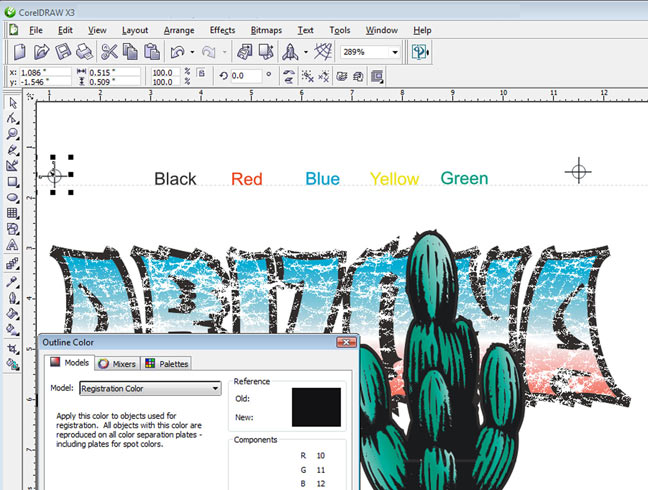
Ifyou want to print an object on all plates in the printing process,including spot-color plates, you can convert it to a registrationcolor. Registration marks, trim marks, and page informationare automatically assigned registration colors.
- In the Swatches panel, click the Registration color swatch , locatedin the first row of swatches, by default.
Note:
To change the on‑screen appearance of theregistration color from the default black, use the Color panel.The color you specify will be used for representing registration-coloredobjects on the screen. These objects will always print as gray on compositesand as an equal tint of all inks in separations.
More like this
Twitter™ and Facebook posts are not covered under the terms of Creative Commons.
Legal Notices Online Privacy Policy